
Hey everyone, it’s Jake here from the powder mixer mixing machine team at AB—you know, the folks who help manufacturers stop stressing about lumpy batches and inconsistent blends. Today I wanna break down something we get asked all the time: how does a powder mixer mixing machine actually nail that uniform mix? It’s not just cranking a button and walking away, y’know? There’s a lot of science and smart design behind it, and I’ve seen this firsthand with everything from chemical powders to spice mixes that our customers rely on every single day.
First off, let’s start with the basics because so many people miss this: not all powders are created equal. You’ve got chemical powders that are super fine, sticky, or prone to static (definitely a tricky one), dry powders that are coarser, maybe even with different densities, and mixes that have both powder and tiny liquid droplets sometimes—like a food or cosmetic blend. If your mixer doesn’t account for those differences from the get-go, you’re never gonna get a uniform mix, no matter how long you run it. That’s why we built our gear to adapt to those variables, but let’s get into the actual mixing mechanisms.
The number one thing that makes a powder mixer work is how it moves the powder inside the chamber. Let’s take ribbon blenders, for example—these are the workhorses for so many industries. They have a U-shaped chamber (perfect for containing powder) with two helical ribbons: one that pushes powder outward and up the center, and another that pushes it inward and down the sides. It’s like a constant loop that’s moving every single particle, not just letting them sit there and stir. I’ve had customers come to us complaining they were using a basic tumbler that only mixed the top layer, so half the batch was heavy at the bottom and half was light on top. Our ribbon mixers fix that because the ribbons create shear and folding—two key mixing actions that get every particle moving. Oh, and if you’re working with chemical powders that need precise blending, our chemical powder mixing machine is designed with extra smooth internal surfaces to prevent buildup, which keeps each particle exposed to the mixing action the whole time. No stuck clumps ruining the batch.
Another big factor: speed and shear control. Too fast, and you’ll get segregation—heavier particles fly to the edges, lighter ones float on top. Too slow, and you’re just moving powder around without blending it. We’ve calibrated our mixers so they hit that sweet spot where the particles are tumbling and folding without bouncing around too much. For example, our 1-ton dry powder blender runs at a variable speed, so if you’re mixing something fine like pharmaceutical powder, you dial it down a little to avoid dust flying everywhere (and trust me, dusty workspaces are a safety hazard no one needs). If you’re mixing coarser granules like fertilizer, you can bump the speed up to get that uniform blend faster. We even have timers that let you set exactly how long to run it, so you don’t overmix and waste time, or undermix and have to re-do the whole batch. That’s a game-changer for small to medium manufacturers who don’t wanna burn through product or time.
Wait, let’s talk about the less talked-about part: material properties and deaeration. A lot of people don’t realize that when you mix powder, air gets trapped between the particles, which can mess with density and consistency. Our mixers have features that help release that trapped air—like vent ports on the chamber or slow-down periods halfway through the mix cycle. For example, when we work with customers mixing powder and small amounts of liquid (think a cosmetic cream base or a chemical paste), our mixer machine for powder and chemical has a spray nozzle that adds the liquid evenly while the ribbons are moving, so it doesn’t clump up on one spot. If you just dump liquid in all at once, you get a big wet ball that’s impossible to break down, but the controlled addition with the moving powder particles spreads every drop out instantly. That’s why so many food and chemical manufacturers swear by our gear for avoiding those “hot spots” where certain ingredients are too concentrated.

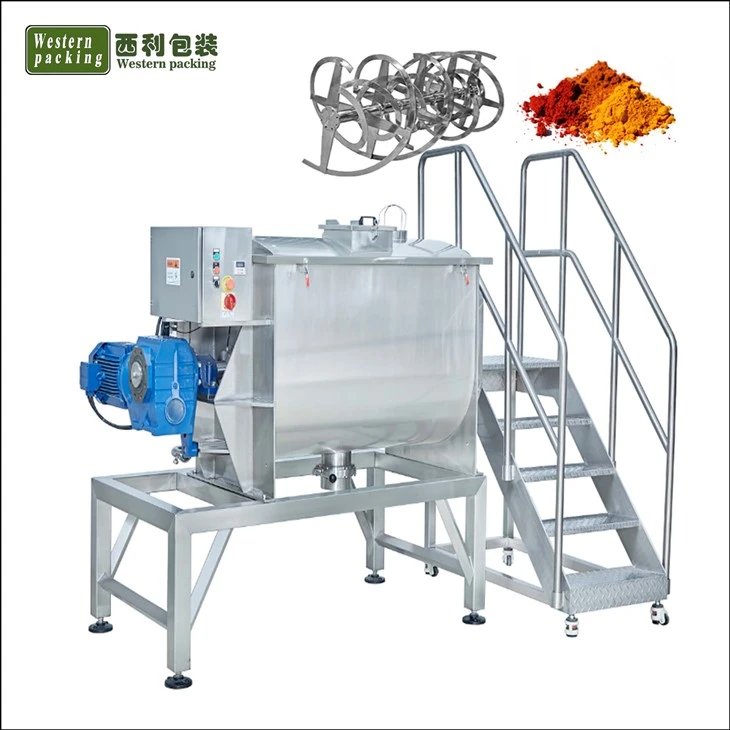
Segregation is the enemy of uniform mixing, right? I touched on that earlier, but let’s dive deeper. Segregation happens when particles of different sizes or densities move apart—like if you shake a jar of sand and gravel, the gravel ends up on top. The good news is, good mixer design fights this. Ribbon blenders fight segregation because they create a cross-flow of particles, not just a circular flow that lets heavy stuff sink. Tumble mixers, on the other hand, can be bad for segregation if they’re not the right type, but our team modified our tumblers to have baffles that break up that circular motion, keeping all particles in motion evenly. Another trick we use is pre-blending ingredients when needed—like if you have a batch with a tiny, highly concentrated ingredient (say, a vitamin in a protein powder), we can help you pre-mix that with a small amount of the other powder first to make it easier to distribute, then load the whole batch into the mixer. That extra step pairs perfectly with our Powder Mixer Ribbon Feed Mixer, which has a charging hopper that feeds the pre-blend evenly into the main chamber, no dumping that could cause uneven distribution.
Let me give you a real example of this working in action. A customer of ours makes organic protein powder—they were using a cheap mixer that left lumps of vanilla flavoring on one side and no flavor on the other, and they were wasting 10% of every batch reworking it. They switched to our powder blender for sale powder mixer 100Kg, which has variable speed and a controlled mixing cycle. The first batch they ran had perfect uniformity—they tested it with a moisture meter at 10 different spots, and all readings were within 0.2% of each other, which is unheard of for their old machine. They told us they cut their rework time by 80% and started delivering consistent products, which made their customers way happier. That’s the whole point here: uniform mixing isn’t just about getting the right product—it’s about saving money, meeting safety and regulatory standards, and keeping your end users coming back.
Wait, what about cleaning? Oh right, if your mixer is hard to clean, leftover powder from the last batch can contaminate the next one, which would make that new batch totally non-uniform. That’s a huge hidden issue a lot of manufacturers overlook. All our mixers are designed with quick-discharge gates that clean out the chamber in minutes, no hard-to-reach corners. The internal surfaces are polished to a smooth finish, so powder doesn’t stick. For industries that need full sanitation (like food, pharmaceuticals, or cosmetics), we can even make them with stainless steel 316, which is easy to sterilize and won’t react with any powders. That’s a big part of ensuring uniform mix too—no cross-contamination messing up your next run.
Let’s wrap this up so it makes sense. At the end of the day, a good powder mixer mixing machine ensures uniform mixing by doing four key things: 1) creating consistent, controlled particle movement (folding, shearing, cross-flow) so every particle is moved equally, 2) calibrating speed and time to avoid segregation or damage to delicate powders, 3) adapting to different powder types (fine, coarse, sticky, with liquids) with features like variable speed and controlled liquid addition, and 4) keeping the mixer clean to prevent cross-contamination that ruins batches.
If you’re tired of inconsistent blends, wasting product, or dealing with messy, outdated equipment, we’re here to help. We’ve worked with everyone from small craft food brands to large chemical manufacturers, and we can tailor a mixer to fit your specific powder needs. No one-size-fits-all, because your powders are unique, and your mixing needs should be too.
If you’re ready to stop stressing about uniform powder mixes and start making products you can be proud of, reach out to our team to talk through your project. We don’t do pushy sales talks—just honest advice about what gear will work best for you, no fine print, no hidden fees. You can check out our range including our chemical powder mixing machine, dry powder blender, ribbon feed mixers, and more, to see what fits.
References
- ASTM International. (2021). Standard Guide for Measuring and Mixing of Powders for Process Industries.
- Doran, P. M. (2013). Bioprocess Engineering Principles (2nd ed.). Academic Press.
- McCabe, W. L., Smith, J. C., & Harriott, P. (2005). Unit Operations of Chemical Engineering (7th ed.). McGraw-Hill.
- Powder and Bulk Engineering. (2022). “Key Factors for Achieving Uniform Powder Mixes.” Industrial Publications.