

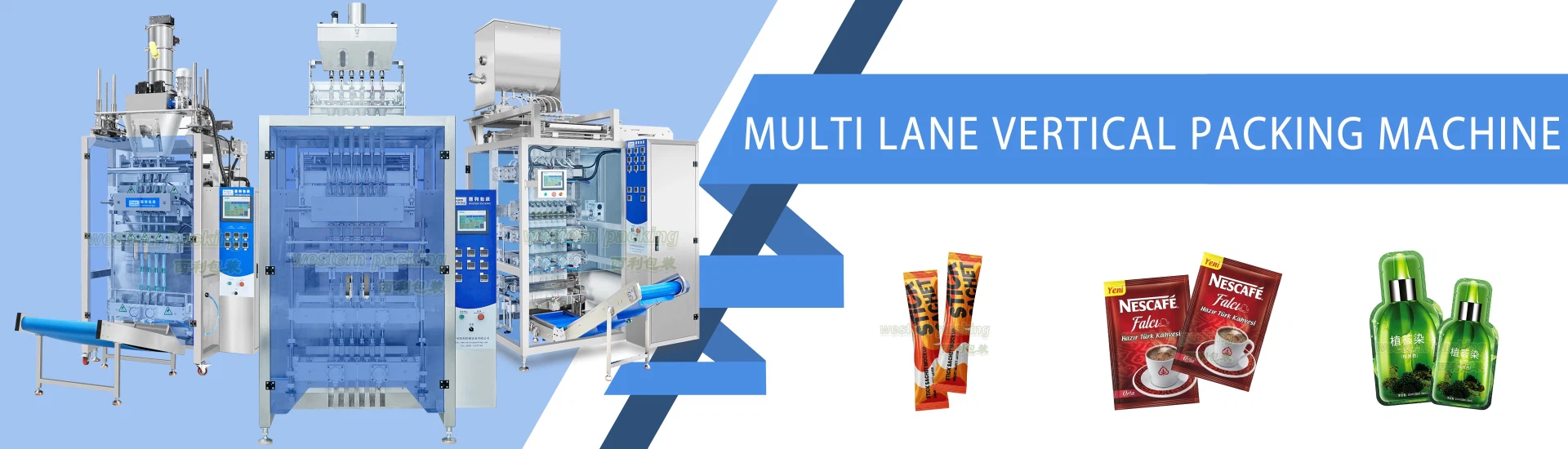
In single-serve packaging, the choice between a three-side seal sachet, a four-side seal sachet, and a stick pack is rarely about appearance alone. It affects film consumption, seal integrity risk, filling-line throughput, and cost per dose. The geometry of the pack is also the geometry of the machine that makes it. Before specifying a Pouch Packaging Machine, it pays to understand what each format demands in production-and how the machine family scales with your product.
The Three Formats, Defined by Their Seams
A 3-side seal sachet is formed from a single film web folded over a V-plow. One edge becomes a crease, and the remaining three edges are heat-sealed. This design is material-efficient because one edge never needs a seal, and the folded bottom creates a natural pocket for filling. The finished pack is flat and rectangular, with a moderate length-to-width ratio.

A 4-side seal sachet uses two film webs brought face-to-face and sealed on all four borders, with no folded edge. The result is a flat, card-like pouch with the largest printable billboard area of the three formats and a symmetric presentation that suits liquids, creams, and pharmaceutical unit doses.

A stick pack is a narrow tube formed around a cylindrical collar, with one longitudinal back seam and two short horizontal end seals. It is the tallest and narrowest profile, designed for pouring directly into a bottle mouth or cup.

The Engineering Trade-Offs That Drive Cost and Risk
Film consumption is where the formats diverge most sharply. A stick pack reduces blank laminate area substantially compared with an equivalent-dose 4-side seal sachet, because it eliminates the wide left and right vertical seal borders. For high-volume commodities-instant coffee, sugar, electrolyte powder-that difference compounds directly into annual rollstock tonnage.
Seal perimeter tells the other side of the story. A 4-side sachet exposes more linear weld length to product contamination than a stick pack. For dusty powders, that extra seal length is extra opportunity for a weak channel. Stick packs concentrate stress at a single T-junction where the vertical fin crosses the horizontal end seal-a known micro-leak point that requires stepped relief grooves in the cross-seal jaws to mitigate.
Product fit follows the same geometry. Stick packs excel with free-flowing powders, granules, and thin liquids that pour cleanly through a narrow opening. The tube becomes a liability with viscous products such as honey or gel, where the floppy tube offers no rigidity to control the pour. Sachets, with room across both width and length, handle a wider rheology window-pastes, creams, and even small solid pieces that would not travel down a narrow forming tube. The 3-side seal's folded edge maximizes internal pocket width for sauces and condiments, while the 4-side seal's fully flat profile is preferred for cosmetic samples and medical patches that need a symmetric, premium presentation.
What the Model Families Tell You
The model families follow the same logic. The WP-480Y through WP-1080Y four-side seal family scales in frame size, power, and weight as lane count and output rise. The WP-480YS through WP-880YS three-side seal liquid family uses a narrower bag width and a lower dosage band, which suits liquid unit doses where seal control and fill accuracy matter more than maximum billboard area. The WP-680Y through WP-1080Y stick-pack family uses a longer, narrower bag profile and heavier forming and sealing hardware for high-speed tubular production.
Two practical notes deserve attention. Model numbers can overlap across format families, so the exact tooling and configuration must be confirmed in writing. Also, a multi-column machine's real output is cycle rate multiplied by active lanes, not cycle rate alone. The specification sheet is a starting point, not a substitute for a line trial.
How the Machine Follows the Format
This is the practical point too many buyers discover late: the pack format selects the machine architecture, not the other way around.
Tubular stick packs run on cylindrical forming collars with a vertical back-seal station. Flat 3-side sachets use a V-plow fold and three perimeter seal jaws. 4-side sachets require opposed dual webs and four-edge sealing rollers or jaws. A single machine frame is rarely a true universal solution without written confirmation of change parts. Multi-format capability exists-some Pouch Packaging Machine platforms can switch between 3-side, 4-side, and stick configurations with modular tooling-but the changeover is a tooling event, not a software toggle. Bag width changes may require replacing the forming device, horizontal seal bar, and punching knife; bag length changes may be an adjustment rather than a parts change.
Throughput also scales differently. Multilane stick-pack platforms commonly run many lanes and can reach high packs-per-minute output at volume. Multilane sachet lines are similarly fast, but sealing and cutting four edges perfectly demands a wider mechanical footprint and distinct jaw precision compared with a standard stick line. The machine choice is therefore a capital-allocation decision tied to dose size, annual volume, and product rheology-not a generic "sachet machine" purchase.
A Decision Framework, Not a Default
Choose stick packs when the dose is a free-flowing solid or thin liquid, the priority is film economy and on-the-go convenience, and volumes justify a multilane line. Choose 4-side seal sachets when you need maximum printable area, a flat and symmetric premium presentation, or the broadest tolerance for pastes and semi-solids. Choose 3-side seal sachets when you want a material-efficient flat pack for sauces, condiments, or liquid doses where the folded edge provides a functional filling advantage at a lower seal-perimeter burden than a 4-side design.
Whichever route you take, the specification should begin with a dimensioned pack drawing and a product sample, not a machine brochure. The right Pouch Packaging Machine is the one whose forming geometry, sealing-jaw profile, and dosing head are matched to the pack format and the product's behavior-because in single-serve packaging, the seam is the product.