
While liquids, powders, and granules can all be automatically packaged using pouch packing machines, they differ significantly in terms of material handling, metering methods, filling processes, and sealing requirements. Inappropriate equipment configuration can lead to issues such as inaccurate dosing, product residue, inadequate sealing, or reduced production efficiency.
What are the specific characteristics of packaging liquids, powders, and granules, and how should one select the appropriate pouch-packaging machine?
1.Liquid Packaging: Focus on Filling Stability and Sealing Performance
Liquid packaging is commonly used for products such as beverages, fruit juices, cooking oils, ketchup, shampoo, hand soap, and various sauces. Because different liquids vary in terms of viscosity, flowability, and physical properties, they impose distinct requirements on filling systems.
For liquids with high flowability-such as water or fruit juice-quantitative filling is typically achieved using pumping systems designed for low-viscosity materials. Conversely, for viscous products like honey, ketchup, or shampoo, it is essential to select the appropriate pumps and filling nozzles based on the specific characteristics of the substance; this prevents issues such as poor product flow or inconsistent filling.
Furthermore, special attention must be paid to the sealing area during the liquid packaging process. If any liquid remains on the opening of the pouch or container during filling, it can compromise the heat-sealing process, potentially leading to leaks.

2. Powder packaging: Focus on auger dosing and dust control
Powder packaging is widely used for products such as coffee powder, milk powder, protein powder, flour, seasoning powders, and spices.
Unlike liquids, powders are easily affected by their own inherent characteristics during conveying and dosing. Some powders flow well, while others may be lightweight, prone to clumping, or even tend to adhere to the inner walls of the hopper. Inconsistent feeding can lead to weight deviations in individual packages.
Currently, auger-based dosing systems are a common configuration for powder packaging. These systems control the volume of powder being conveyed through the rotation of an auger, ensuring precise, metered dispensing based on pre-set parameters.
For materials that generate significant dust, a dust extraction system can be integrated to minimize the dispersion of powder in the filling area. This prevents dust from accumulating on the bag opening, which could otherwise compromise the quality of the subsequent sealing process.

3. Granule packaging: Focus on weighing accuracy and dispensing speed
Granular packaging is commonly used for products such as granulated sugar, table salt, rice, nuts, seeds, coffee beans, and various other small-particulate food items.
Granular materials generally flow more easily than powders; however, they vary significantly in terms of particle size, shape, and weight. For instance, while granulated sugar particles are relatively uniform, items like nuts or seeds can exhibit substantial differences in shape and individual unit weight. These factors influence both the metering method employed by the equipment and the final quality of the packaging.
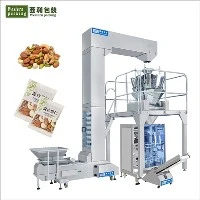
For small-granule products, metering systems based on either volumetric (measuring cups) or gravimetric (weighing) principles can be selected depending on specific packaging requirements. If high precision regarding the weight of each individual bag is required, a multihead weigher may be used; this system calculates combinations from multiple weigh hoppers to select the set that most closely matches the target weight before discharging the product.
Additionally, attention must be paid to the sealing area during the packaging process. If granules fall into the area where the bag is to be sealed, it can compromise the integrity of the seal.

4.What are the differences between liquid, powder, and granule packaging machines?
The primary differences among packaging machines for liquids, powders, and granules lie in their material-conveying methods and metering systems. Liquid packaging typically relies on a pump-based system for precise filling; the choice of filling pump and nozzle must be tailored to the liquid's viscosity, while also ensuring that no dripping occurs during the process and that no liquid residue remains in the sealing area. Powder packaging generally employs an auger-metering system, where the rotation of an auger controls the discharge volume-a method designed to address challenges such as inconsistent powder flow, clumping, and the generation of dust during filling. Granule packaging, by contrast, often utilizes multihead weighers or volumetric cup-metering systems to dispense specific quantities based on the size, shape, and target weight of the granules, ensuring that each package meets the required weight specifications.
Beyond the metering methods, these three types of equipment also differ in their structural configuration and sealing requirements. Liquid packaging prioritizes a high-integrity, leak-proof seal; powder packaging requires measures to minimize the impact of dust on the sealing zone; and granule packaging must prevent particles from becoming trapped within the heat-sealing area. Consequently, when selecting a pouch packing machine, one should not focus solely on the machine's appearance or packaging speed; rather, the equipment configuration must be determined based on the specific characteristics of the material, the packaging specifications, and the unique requirements of the production process.