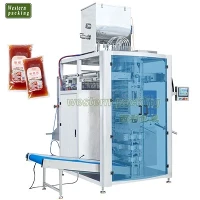

If you’re a sauce manufacturer – from small-batch artisanal producers to large-scale food processing plants – the reliability of your liquid sauce packing line can make or break your production, bottom line, and brand reputation. I’ve spent the better part of a decade as a liquid sauce packing machine supplier, working directly with teams that have dealt with the nightmare of a misaligned filler that overfills sachets, a sealing unit that bursts containers, or a labeling error that sends out expired product. The truth is, quality control (QC) for these machines isn’t just a “checklist step” – it’s a core part of designing, building, and maintaining equipment that can handle the unique quirks of liquid sauces, from thick tomato paste to delicate soy sauce. Let’s break down what goes into rigorous QC for liquid sauce packing machinery, and why it matters more than any other component of your production line.
First, let’s get specific about the unique challenges liquid sauce packing machines face that other filler equipment doesn’t. Sauces aren’t uniform: tomato paste is so thick it’s almost paste-like, while soy sauce is thin and watery, dipping sauces often have small particulate matter (like chili flakes or sesame seeds), and marinara sauce varies in viscosity batch to batch, even from the same brand. A one-size-fits-all QC process that works for a water filler will fail here, because it doesn’t account for how these textures interact with nozzles, seals, and pump systems. That’s why, for example, when we build specialized units, we tailor QC protocols to the sauce type – whether you’re running a high-output line for tomato paste, a compact line for small-batch soy sauce, or a high-speed sachet line for condiment dipping sauces.
Let’s start at the very beginning: incoming component QC. You’d be surprised how many machine manufacturers skip this step, relying on cheap, unvetted parts to cut costs. For us, every single part that goes into a liquid sauce packing machine is tested before it even reaches the assembly floor. Let’s take a critical component: the filling nozzle. Nozzles for sauce can be made of food-grade stainless steel, polished to a smooth finish to prevent sauce from sticking and growing bacteria, or precision-machined to handle viscous products without dripping. We test each nozzle for dimensional accuracy (even a 0.1mm misalignment can cause overfilling or uneven flow) and surface roughness (ISO 46 finish, per food safety standards) before it’s approved for assembly. For multi-head filling machines, which are often used for high-output production lines that need to fill 50+ containers per minute, we also test the sync between individual heads – a misaligned head here can lead to entire batches of over/under-filled product, which is a costly waste of ingredients.
Viscosity testing is another non-negotiable QC step. Liquid sauces have a wide range of viscosities, and a machine that works for thin soy sauce will struggle with thick tomato paste. We’ve seen clients try to use a standard water filler for tomato paste, only to have it clog nozzles, create air pockets in the fill, or leave half the sauce in the hose. In our QC process, every machine is calibrated with the actual sauce the client will be using – that means running test fills with their specific product, measuring flow rate, and adjusting pump pressure or nozzle size to match. For example, our tomato paste filling machine is tested with standard high-viscosity tomato paste (100,000 cP, centipoise) to ensure that every fill is within +/- 1% of the target volume, even at speeds up to 60 containers per minute. We also account for temperature, because sauce viscosity changes as it heats or cools – a batch of tomato paste that’s warm from manufacturing will flow differently than a cold batch, so we test the machine across a range of operating temperatures to ensure consistency.
Seal integrity is probably the most important QC step for liquid sauce packing, because a bad seal means spilled product, wasted inventory, and potential customer complaints. For sachet-style packing, this is even more critical – think of a ketchup sachet that bursts in a lunch bag, or a soy sauce sachet that leaks into a takeout container. Our QC process for sealing involves two parts: first, testing the seal’s tensile strength to ensure it can withstand pressure, and second, vacuum testing to check for microscopic leaks. For sachet packing, we run what’s called a “burst test”: we fill a sample sachet with water, apply increasing pressure until the seal breaks, and set our minimum at 2x the maximum pressure the sachet will encounter during shipping and storage. For thicker sauces or bulk packaging, we also use a dye penetration test – we fill containers with a colored liquid, submerge them in water, and check for any dye seepage, which would indicate a faulty seal. Our tomato sauce sachet packing machine, for example, undergoes 100 seal tests before it leaves our facility, with a 0% failure rate requirement to meet food safety standards.
Food safety compliance is a huge part of QC for any equipment that comes into contact with sauce, and we take this seriously. All materials used in liquid sauce packing machines must meet FDA 21 CFR and EU 1935/2004 standards for food contact, which means no lead, no toxic coatings, and surfaces that are easy to clean and sanitize. Our QC team swabs every component that touches sauce before and after assembly to check for residual contaminants, and runs a series of sanitization tests to ensure the machine can be fully cleaned in line with food industry standards – a critical feature for producers that need to switch between sauce types (like from tomato sauce to mustard) without cross-contamination. We also document every step of this process, so clients receive a full compliance certificate when their machine is delivered, which is necessary for passing food safety audits.
Performance testing under real-world conditions is another key QC step that sets our machines apart from cheaper alternatives. We don’t just run test fills with water – we use actual sauce, run the machine for hours on end, and simulate common production issues to see how it holds up. For example, we might test a dipping sauce packing machine with a sauce that has small particulates, to ensure that the pump and filter system don’t clog, and that particulates are evenly distributed in each fill (no sachets with all the chili flakes at the top or bottom). We also test for downtime – how easy is it to change parts, clean the machine, or troubleshoot a minor issue? Downtime costs manufacturers thousands of dollars per hour, so our QC process includes testing for ease of maintenance, from the size of the nozzles to the clarity of the control panel displays. For multi-head filling machines, which have more moving parts, we test for long-term performance over a 24-hour run, checking for wear on pumps, seals, and nozzles, to ensure that the machine maintains accuracy and speed without slowing down.
Let’s talk about common QC mistakes we see other manufacturers make, because they can lead to big problems for clients. One mistake is rushing the calibration process – some manufacturers calibrate their machines with water, not the actual sauce, which means when the client runs their product, the fill volume is off. Another is skipping long-term performance testing; a machine that works for 10 test fills might start leaking or overfilling after 1,000 fills, which is exactly what happened to a small artisanal sauce client we worked with a couple years ago. They bought a cheaper machine that only used water for testing, and within a month, they had to throw away 500 containers of sauce because of fill inaccuracies. We also see manufacturers cut corners on seal testing, which leads to high return rates for leaking packaging – not only does that hurt the client’s revenue, it damages their brand reputation.
For sauce producers, investing in a machine with robust QC processes isn’t just about avoiding mistakes – it’s about scaling your production efficiently. Whether you’re just starting out with a small line for homemade sauce, or you’re expanding to meet national demand for your condiment, a machine that’s been rigorously tested will give you consistent fills, fewer rejects, and lower maintenance costs. For example, our line of liquid sauce packing machines is designed with QC built in at every stage, from component sourcing to final testing, so clients can trust that their machine will work as advertised, even when running high-volume production. If you’re looking for a machine for a specific sauce type, like tomato paste, soy sauce, or dipping sauce, we offer specialized models that are tailored to those products – check out our tomato paste filling machine, soy sauce packing machine, tomato sauce sachet packing machine, multi head filling machine, and dipping sauce packing machine for more details on our specialized lines.


When you’re shopping for a liquid sauce packing machine, don’t just look at the price tag – ask the manufacturer about their QC processes. What components do they test? Do they calibrate with your actual sauce? What kind of seal testing do they do? A reputable supplier will be able to walk you through their QC protocols, provide compliance documentation, and offer references from other sauce producers. At the end of the day, the quality of your packing machine directly impacts the quality of your product, and that’s what your customers care about most. If you’re ready to learn more about our liquid sauce packing machines, or to discuss your specific production needs, reach out to our team to connect for a procurement consultation. We’ll walk you through our QC process in more detail, help you select the right machine for your sauce type and production volume, and ensure you have all the support you need to keep your line running smoothly.
References
- Food and Drug Administration. (2023). CFR Title 21, Part 177: Indirect Food Additives: Polymers. U.S. Department of Health and Human Services.
- European Commission. (2004). Regulation (EC) No 1935/2004 of the European Parliament and of the Council on materials and articles intended to come into contact with food. Official Journal of the European Union.
- International Organization for Standardization. (2020). ISO 21483: Packaging – Complete, filled transport packages and unit loads – Vertical impact test. ISO.
- Food and Agriculture Organization of the United Nations. (2021). Food Processing Equipment for Small and Medium-Sized Producers. FAO Agricultural and Food Engineering Technical Guide.