
Hey everyone! If you’ve ever been in the market for powder mixing gear, you’ve probably asked yourself (or Googled) “what’s the capacity of a typical powder mixing machine?” — and honestly, that’s such a good question, because it’s not a one-size-fits-all answer. I run a powder mixing machine supply business, and I get this question every single day from people across industries: small batch craft producers, big chemical plants, detergent manufacturers, you name it. So let’s break this down real, no-jargon talk, and cut through the vague numbers you might see online.
First off, let’s get one thing straight: “typical” doesn’t mean generic. The capacity of a powder mixing machine depends on way more than just how big the tank looks. Like, if you’re mixing fine cosmetic powders vs. coarse detergent granules, that changes everything. Even the type of mixer matters — a V Blender Powder works totally different from a trough ribbon blender, right? But let’s start with the basics most people care about when they’re first shopping.
Let’s start with the two key terms you’ll hear thrown around: working capacity vs. total volume. Total volume is the actual size of the mixing chamber (like, if your tank is 100 liters total, that’s how much space it takes up when empty). Working capacity is how much powder you can actually fill it with without making a mess or ruining the mix. For most standard mixers, that’s 50-70% of the total volume. Fill it less than 50% and you’re wasting machine space; fill it over 70% and the powder can’t tumble or move freely — you’ll get lumps, uneven mixes, and even put extra strain on the motor. That’s a super important detail most beginners miss, so I always make sure to point that out to every customer.


Now, let’s talk about actual typical capacities. If you’re a small to medium business, say a startup making dietary supplements or small-batch cleaning products, you’re probably looking at something in the 10 Kg to 500 Kg range per batch. That’s the sweet spot for most indie operations and even some mid-sized factories. If you’re scaling up and running 24/7, you might go bigger — up to 5,000 Kg per batch or more, but that’s for industrial giants, not your average shop.
Wait, let’s narrow this down to common use cases, because that’s where most people struggle. If you’re in detergents, like making washing powder, you need a mixer that handles bulk, free-flowing granules. A lot of our customers who make washing powder reach for a unit that’s 200 Kg to 1,000 Kg per batch, because that’s enough for a day’s production without changing parts too often. We have a Washing Powder Mixing Machine line that’s super popular here because it’s built for that exact use case — heavy-duty, easy to clean, and calibrated for consistent mixes of detergent powders, enzymes, fragrances, all that stuff. I can’t tell you how many people come to us after trying cheaper mixers that couldn’t handle the coarse nature of washing powder and left uneven blends; that’s why matching the machine to your product is non-negotiable, not just capacity.
If you’re in the chemical industry, things get a little different. Chemical powders are often more abrasive, or need to be mixed at specific ratios, so their mixers need to handle precise batches too. A lot of our chemical customers go for units starting at 50 Kg up to 2,000 Kg per batch, depending on whether they’re making small specialty chemicals or bulk industrial additives. We have a Chemical Powder Mixing Machine line that’s built with corrosion-resistant parts, which is a must for acidic or reactive powders — that’s not something you want to cut corners on, trust me.
Let’s circle back to that working capacity vs. total volume thing with an example. We have a super popular unit called the Powder Mixing Machine 100 Kg — wait, what does that number mean? That’s working capacity, right? So that machine’s total volume is about 150 liters, because we recommend filling it to 66% of total volume for powders, which gets you 100 Kg per batch (assuming average powder density, like 0.66 g/cm³, which is standard for most fine powders). If you tried to fill that same machine with a denser powder, like some metal powders (density 2.7 g/cm³), you’d only get about 220 Kg total before hitting that 66% fill rate, so the label “100 Kg” is specific to the product density it’s designed for. That’s why you can’t just grab a machine off Amazon and assume the Kg number is universal — you have to match it to what you’re mixing.
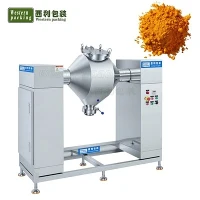
Another common mixer type is the V Blender Powder, which is super popular for fine, delicate powders that don’t need a lot of pressure to mix (like pharmaceutical powders or cosmetic pigments). V blenders are great because they tumble powder as they rotate, and their working capacity is a bit different — usually between 30-50% of total volume, because the V shape means there’s dead space at the bottom. So a V Blender Powder with a total volume of 200 liters would have a working capacity of about 60-100 liters, which is roughly 40-80 Kg for fine powders, perfect for those small-batch, high-precision mixes.
Now, what’s a “typical” mix for most general-purpose mixers? If you’re not making detergents, chemicals, or pharmaceuticals, and just mixing things like baking ingredients, fertilizer additives, or even art supplies, your go-to is probably a Powder Mixer Blender in the 50 Kg to 200 Kg per batch range. These are versatile, work for most free-flowing powders, and are easy to clean when you switch products. We get a lot of cafes or artisanal food producers who use these, because they scale well as their business grows — start with a 50 Kg unit, then move up to a 150 Kg or 200 Kg one when you need more output.
Wait, let’s bust a myth here: more capacity doesn’t always mean better. A lot of people think if they buy the biggest mixer they can afford, they’ll save money, but that’s not true. If your production volume only needs 50 Kg per batch, a 500 Kg mixer will use way more energy, take longer to clean between batches, and actually cost you more per unit of powder. It’s like buying a semi-truck to commute to work — overkill, and not practical. That’s why we always ask customers a few key questions first: what powder are you mixing? What’s your production output per day? How many different products do you need to mix? That helps us pick the right capacity, not just the biggest one.
Another thing that affects capacity: batch time. A 100 Kg machine that takes 30 minutes per batch will output 200 Kg per hour, while a 200 Kg machine that takes 45 minutes per batch will output 266 Kg per hour. So it’s not just the size of the batch, it’s how fast you can get it done. Our mixers are calibrated to get uniform mixes in 5-15 minutes, depending on the product, so that’s a big part of their capacity too — not just how much they hold, but how efficient they are at holding it.
Let’s talk about industry averages, just to give you a baseline. For small businesses (1-5 employees), typical mixer capacity is 10-100 Kg per batch. For medium businesses (5-50 employees), it’s 100-1,000 Kg per batch. For large industrial operations (50+ employees, 24/7 production), it’s 1,000-5,000+ Kg per batch. But again, these are rough numbers — I’ve seen small businesses making specialty coffee mixes use a 150 Kg unit, and big detergent plants start with 2,000 Kg units, so it all varies.
If you’re still unsure which capacity is right for you, here’s a quick checklist I give all new customers: 1) Weigh your daily powder output needs. Let’s say you need to make 500 Kg of product a day. If you run 2 batches a day, you need a 250 Kg per batch machine; if you run 5 batches a day, you can use a 100 Kg per batch machine. 2) Check your powder density. Fine powders are lighter, so you’ll get more Kg per liter of volume than dense powders. 3) How often do you switch products? If you change products every batch, you’ll want a smaller machine so it’s faster to clean, even if you could handle a bigger batch.
At the end of the day, the “typical” capacity of a powder mixing machine isn’t a fixed number. It’s tailored to your product, your business size, and your production goals. If you’re just starting out, a small general-purpose unit (50-200 Kg) is a safe bet, and you can upgrade as you grow. If you’re in a specific industry like detergents or chemicals, there are specialized units built for exactly your needs, so don’t try to force a one-size-fits-all mixer into a role it’s not designed for.
If you’re ready to shop around, we have all the options I mentioned today — from the compact 100 Kg units perfect for scaling startups, to heavy-duty washing powder mixers, chemical-grade mixers, and V blenders for fine powders. Whether you need a small unit for your new supplement brand or a large industrial mixer for your detergent line, we can help you pick the right capacity and type for your needs. Hit us up to chat through your requirements, no pressure, just honest advice.
References:
- Powder Handling and Mixing: A Practical Guide, 2nd Edition, by Paul E. Arvidson
- Industrial Mixing Technology: Selection and Application, by James C. Fabian
- Equipment Guide for Food and Chemical Powder Processing, National Institute of Standards and Technology (NIST)
- Batch Mixer Capacity Standards, American Society of Mechanical Engineers (ASME)