

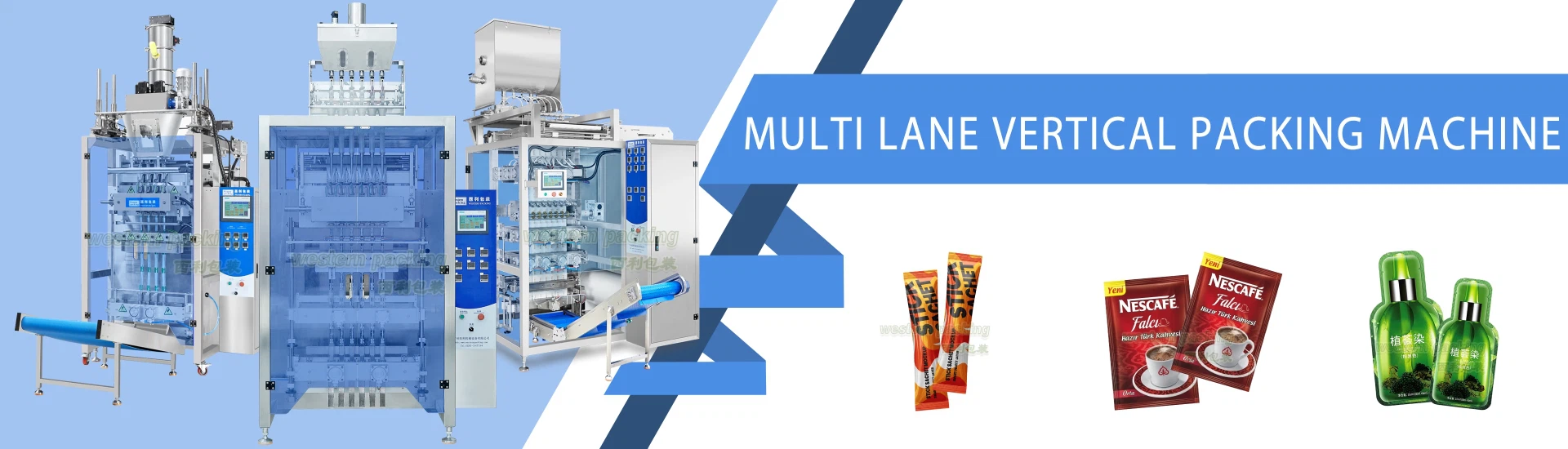
The advantage of multi-lane liquid packaging machines lies in their high efficiency, but what truly determines the value of the equipment is its ability to maintain consistent movement, precise filling, and stable sealing and cutting across each row under high-speed operation. Any synchronization deviation can lead to uneven filling, misaligned sealing, or even the scrapping of the entire batch. Therefore, synchronization accuracy and operational stability are a complex system engineering project.
Unified Drive System: The Foundation of Synchronization
Synchronization of multi-lane machines is not merely about making multiple mechanisms operate simultaneously, but about achieving multi-axis coordination through a unified control system. Servo motors work in conjunction with a PLC controller, establishing strict time and position relationships via electronic cams to precisely coordinate the actions of film pulling, filling, sealing, and cutting. Phase control and encoder closed-loop feedback correct errors in real time, ensuring consistency across each lane during high-speed operation.
High-precision measurement system: ensuring consistency in every column
The biggest challenge with multi-lane filling machines is ensuring consistent filling volume across each row. The stroke accuracy, sealing condition, and independent drive of the filling pump directly affect filling accuracy. High-end equipment typically features single-row compensation, allowing for fine-tuning of specific rows. Furthermore, for low-viscosity liquids, a back-suction design after filling prevents dripping and improves sealing quality.


Film stretching and slitting system: key to stability
Unstable packaging film operation directly affects synchronization. The servo film pulling system can precisely control the bag length, and the acceleration and deceleration curves reduce impact; the photoelectric tracking system corrects the cutter position in real time; multi-lane slitting tension control, through floating rollers and automatic correction, ensures that the tension of each row of film is consistent, avoiding deviation or uneven sealing.
Sealing and cutting system: a manifestation of synchronized effect
Sealing and cutting are the most direct indicators of synchronization precision. Multi-point temperature control and PID regulation ensure consistent temperature, while an elastically compensated pressure structure ensures uniform sealing. Matching the cutting speed to the film pulling speed and regularly replacing the cutter prevents misalignment and tearing, ensuring consistent finished products in each lane.
Mechanical structure: the basis of stability
At high speeds, the rigidity of the frame, and the machining accuracy of the guide rails and lead screws determine the long-term stability of the equipment. Structural instability amplifies vibrations and affects synchronization. A well-designed structure ensures that each lane remains consistent throughout long-term operation.
Detection and Feedback System: Dynamic Correction Guarantee
Online detection systems (photoelectric, bag length, and material-free detection, etc.) can provide real-time feedback on deviations, automatically adjust the film stretching length or cutter position, and alarm or stop the machine in abnormal situations to prevent problems from escalating and ensure long-term stable operation of the equipment.
Debugging and Operation: Key Factors Affecting Actual Results
Even with superior equipment performance, improper debugging and operation can affect synchronization. Initial installation requires calibration of multi-lane alignment, filling volume, and phase; parameter rematching is necessary when changing products; routine maintenance of seals, cutting tools, and tension systems is crucial for long-term stability. Many synchronization problems actually stem from inadequate operation or maintenance.
The synchronization accuracy and stability of multi-lane liquid packaging machines are the result of the combined efforts of the control system, metering system, film stretching system, sealing and cutting system, mechanical structure, and operation and maintenance. Only when each link reaches a high level can the equipment maintain consistency over a long period of high-speed operation, achieving a balance between high efficiency and high yield. In short, the competitiveness of multi-row equipment lies not only in speed, but also in the consistent "fast and accurate" performance of each lane.


