

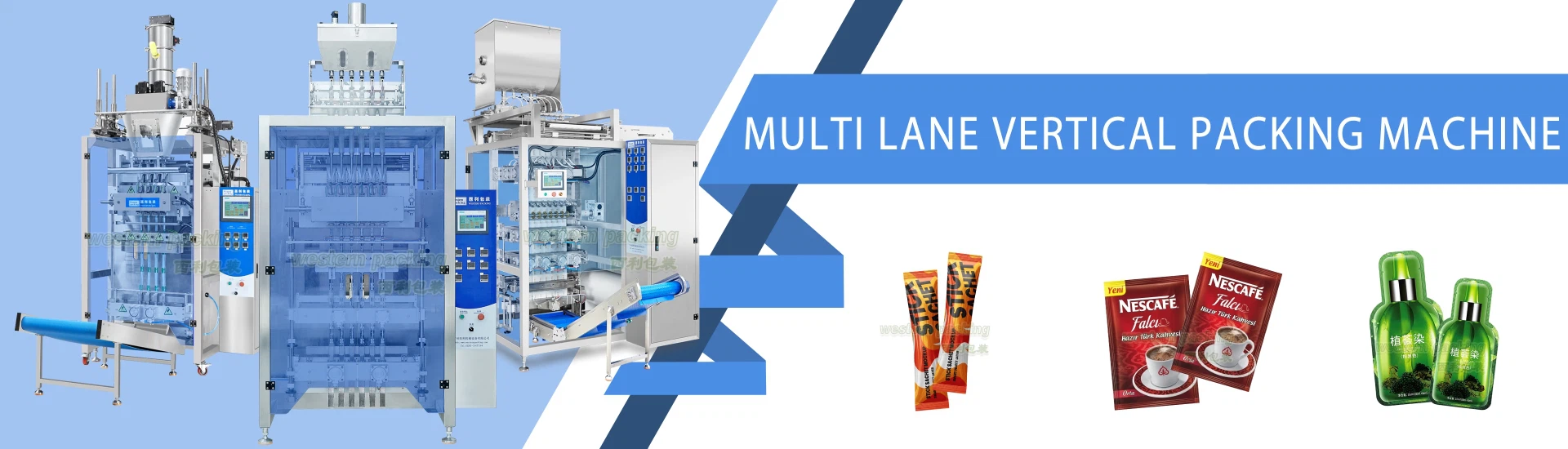
Many customers in the food, daily chemical, or pharmaceutical industries get stuck on one question when choosing a liquid packaging machine: should they choose a single-lane or multi-lane (e.g., six-lane) machine?
This question seems simple, but choosing the wrong one can lead to either insufficient production capacity or idle equipment, both of which will cause significant headaches.
Device Type: The Essential Difference Between Single-lane and Multi-lane
From the perspective of the equipment itself, a single-lane liquid packaging machine produces only one bag at a time. Its overall structure is simple, easy to operate, and requires less space and personnel, making it more suitable for small- to medium-batch production or start-ups. In contrast, a multi-lane liquid packaging machine (e.g., six-lane) can produce multiple bags simultaneously, making it a typical high-speed automated machine suitable for companies with stable orders and continuous production needs. The biggest difference between the two is not whether they can produce, but rather the gap in production efficiency and scalability.
Production capacity gap: the core factor determining product selection
This difference is most evident in production capacity. Generally, a single-lane machine produces about 30 to 60 bags per minute, while a six-lane machine can reach 180 to 360 bags per minute, with overall efficiency typically 3 to 6 times that of a single-lane machine. Therefore, if a company's daily production demand is not high, such as within tens of thousands of bags, a single-lane machine can basically meet the needs; however, if orders continue to grow, especially if long-term supply is required, multi-lane machines are almost a necessity, otherwise, it is easy to encounter the problem of "orders coming in but production capacity not keeping up."


Product Features: Different solutions for different liquids
Besides production capacity, the properties of the liquid itself directly affect equipment selection. For highly fluid, watery liquids like soy sauce and beverages, equipment requirements are relatively low; both single-lane and multi-lane systems can be used. However, for viscous liquids like honey and shampoo, a more stable metering system is needed, and multi-row systems typically offer better stability during continuous operation. For products that easily foam, such as dish soap, the equipment needs an anti-foaming design, while for liquids containing particles, like chili sauce, a specialized metering structure is required. If these details are not considered carefully in the early stages, problems such as inaccurate metering and poor sealing can easily arise later.
In general, single-lane equipment is more suitable for small-batch, flexible production needs, while multi-lane equipment represents high efficiency and scalability. When making a choice, companies should not only look at the price of the equipment, but should also make a more reasonable and long-term judgment based on their own capacity requirements, product types, and future development plans.


