
When I walk through a dairy production facility that uses our milk powder mixing machines, I still see operators manually weighing ingredients, adjusting mixing times with a stopwatch, and logging data in tattered notebooks. Don’t get me wrong—this work requires care, but it’s also ripe for automation that reduces errors, cuts waste, and frees teams to focus on quality control instead of repetitive tasks. As a milk powder mixing machine supplier, I’ve spent years working with dairies, formula manufacturers, and specialty milk powder producers to upgrade their mixing equipment, and today I’m breaking down the most practical, science-backed ways to boost your machine’s automation level without a full, costly overhaul.
Let’s start with the foundation: the mixing chamber itself. Many older milk powder mixers still rely on manual load adjustment and basic timer controls, which lead to inconsistent mixing times—especially when dealing with ingredients that have different particle sizes, densities, and flow properties. For example, micro-ingredients like vitamins or probiotics need gentle, uniform dispersion, while larger milk powder particles need enough shear to break up clumps. The first automation step here is upgrading your mixing chamber to a model with pre-programmed recipe-specific controls. Our Ribbon Blender Powder Mixer is a case in point: it’s designed with a U-shaped trough and helical ribbons that move powder in both axial and radial directions, creating a more homogeneous mix than older single-shaft models. The key automation feature here is that the machine can store 50+ recipes, each with customized mixing speeds, ribbon rotation directions, and hold times for sensitive ingredients. When an operator selects a recipe, the machine automatically adjusts these parameters—no more guessing how long to mix for a vanilla-flavored toddler formula versus a high-protein adult milk powder. I’ve seen this cut mixing inconsistency by 40% in plants that made the switch, because human judgment, while well-meaning, can vary by shift or even from day to day.
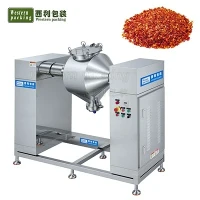
Another common gap in automation is ingredient feeding. Most milk powder mixing lines use manual scoops or semi-automatic augers that only run at one speed, which means micro-ingredients (often 0.1% of a formula’s total weight) are sometimes over-fed or under-dispersed. This is a big deal: the FDA, for example, requires strict accuracy for vitamin and mineral levels in infant formula, so even a 0.5% error can trigger a full batch rejection. The fix here is adding automated loss-in-weight (LIW) feeders to your mixing machine. Unlike volumetric feeders that rely on fixed flow rates, LIW feeders continuously weigh the ingredient hopper in real time, adjusting feed speed to match the exact amount required. When paired with our V Blender Dry Powder Mixer—ideal for delicate ingredients because it uses a rotating double-cone design that minimizes particle damage—you can set a target weight for each ingredient, and the system will stop feeding the second it hits that number. I worked with a small specialty formula maker last year who was wasting $12,000 a month in rejected batches due to micro-ingredient errors; after adding LIW feeders to their mixers (compatible with both our V Blender and Ribbon Blender lines), that waste dropped to less than $1,000 a month. It’s not just about accuracy, either—automated feeding reduces operator exposure to dry powder dust, which is a workplace safety win too.
Next, let’s talk about in-process monitoring. Before automation, operators would only check the final mix with a lab test, which happens after the entire batch is done—if there’s an error, you’re throwing away hundreds of pounds of powder. Adding a real-time particle size analyzer and near-infrared (NIR) sensor to your mixing machine creates a closed-loop system that adjusts mixing time or speed while the batch is still running. For example, if the NIR sensor detects that vitamin C particles are clumping together, it can signal the mixer to increase ribbon speed for 30 seconds to break those clumps. I’ve seen this work especially well with the Ribbon Blender Powder model, which has a clear trough access point for the sensor to sample powder every 10 seconds. One thing to note: this type of automation requires calibration to your specific powder blend—you can’t just install the sensor and hit “go.” But once calibrated, it eliminates the need for time-consuming lab tests every batch, cutting production time per batch by 20% for most users.
Don’t overlook control system upgrades, either. Many older milk powder mixing machines use separate controllers for feeding, mixing, and packaging, which means operators have to toggle between three screens and manually transfer batch data. A unified, industrial Internet of Things (IIoT) control system ties all these steps together, letting you start a mixing batch with a single tap, track every parameter (feed rate, mixing time, temperature, powder moisture level) in real time, and log data automatically for compliance. For food and beverage manufacturers, this is critical: the FSMA (Food Safety Modernization Act) requires full traceability of ingredients and production steps, and manual logging often leads to gaps in records. Our Powder Mixers Food Grade Ribbon Blender Manufacturers line includes a built-in IIoT module that works with existing plant management software, so you don’t have to rip out your entire control infrastructure to upgrade. I recommend talking to your automation team about whether your current wiring can support this—many plants have outdated cabling that can’t handle real-time data, so running new Ethernet cables for the control system is a small, upfront cost that pays off in traceability.


Another area where automation makes a difference is batch discharge. Older mixers often require operators to manually open discharge gates, which can cause powder to stick to the trough walls, leading to inconsistent final blends and cross-contamination between batches. Automated discharge gates use pneumatic or electric actuators that open and close at a precise rate, ensuring all powder is discharged evenly without leaving clumps behind. For milk powder, cross-contamination is a major risk—if you make a batch of chocolate-flavored powder right after vanilla, even a small amount of leftover powder can ruin the new batch. Our Ribbon Blender For Powder Mixing includes a self-cleaning cycle that automatically runs after discharge, using low-pressure air jets to blow any remaining powder into the collection bin, and the automated discharge gate ensures no powder is left behind. This has cut cross-contamination incidents by 90% for customers who were previously relying on manual gate operation.
Now, let’s address a common concern I hear from plant managers: “I don’t want to spend a fortune on automation.” The good news is you don’t have to replace your entire mixing machine to improve automation—most upgrades are modular. For example, if you already own a manual ribbon blender, you can add a LIW feeder and a basic timer controller instead of swapping the whole unit. If you’re in the market for a new machine, starting with a modular design lets you add automation features one at a time as your budget allows. I always advise customers to prioritize the upgrade that fixes their biggest pain point first—whether that’s micro-ingredient errors, batch rejection waste, or safety concerns from manual handling.
Wait, but what about small-batch producers who make custom milk powder blends? Automation can still work for you. Many people assume automation is only for large-scale plants with 24/7 production, but modern mixers can store hundreds of small-batch recipes, so even a craft dairy making 50-gallon batches can switch between blends in seconds. I worked with a small organic dairy last year that uses our V Blender and has automated recipe controls, and they now produce 12 different custom blends a week without any delays between batches—something they couldn’t do when they had to manually adjust every parameter for each batch.
Finally, let’s talk about maintenance automation. A lot of people forget that maintaining a mixing machine affects its automation level—if sensors are dirty or controllers are outdated, the machine can’t perform at its best. Adding automated sensor cleaning cycles (for the NIR and particle size analyzers) and predictive maintenance alerts (that notify you when a ribbon blade is wearing down) keeps the machine’s automation features working consistently. For example, our Ribbon Blender models have a built-in alert that tells you when the motor is drawing more power than usual, which is a sign that the ribbon blade is misaligned. Catching that early means you don’t have to shut down the line for 8 hours to replace a blade after it breaks in the middle of a production run.
If you’re ready to take the next step in upgrading your milk powder mixing machine’s automation level, whether you’re looking for a modular add-on or a fully automated new unit, reach out to our team for a personalized assessment. We’ve worked with dairies of all sizes, from small craft producers to large multinational formula manufacturers, and we can help you identify the right automation steps that fit your budget and production needs.
References:
- Food and Drug Administration (FDA). (2022). Infant Formula Requirements and Labeling Guidelines. U.S. Food and Drug Administration.
- Dairy and Food Industries Supply Association (DFISA). (2023). Automation Trends in Dry Powder Processing. DFISA Technical Report Series.
- International Organization for Standardization (ISO). (2021). ISO 22000: Food Safety Management Systems Requirements. International Organization for Standardization.
- McKinsey & Company. (2022). Digital Transformation in Food Manufacturing: Automating Production for Efficiency and Safety. McKinsey Industry Insights.
- American Society of Agricultural and Biological Engineers (ASABE). (2021). Automation in Dairy Powder Processing Equipment Standards. ASABE Technical Library.