
If you’re running a manufacturing plant that relies on consistent powder blends—whether it’s detergent, ice cream base mixes, or baking powders—you’ve probably asked yourself: “Can my mixing machine hold up when it’s running 12, 16, even 24 hours straight?” As a supplier of powder mixing equipment, I get this question all the time. It’s not just a theoretical concern; every unplanned downtime, every off-spec batch, cuts into profits and pushes project timelines off track. So let’s break down how reliable powder mixing machine mixers actually are in continuous operation, what makes them fail, and how to pick one that won’t let you down when you need it most.


First, let’s get one thing straight: not all powder mixers are built the same. I’ve seen plants run the same basic model for 5+ years of near-continuous use without a single major overhaul, and I’ve seen another brand lock up after 3 months of nonstop runs. The biggest differentiator? The design and materials, and how well it’s matched to the exact powder you’re processing. That’s why a lot of our customers start by checking out our Powder Mixing Machine Blender first—this line is built with heavy-duty components specifically for sustained runs, so it’s a go-to for everyone from small craft food producers to large FMCG factories.
Let’s talk about the biggest threats to continuous operation, because that’s where reliability gets tested. Number one is wear and tear from friction. When you’re mixing dry powder, especially things like abrasive detergent particles or fine baking powders, the moving parts inside the mixer are constantly rubbing against each other. If the parts are made of thin, low-grade steel, they’ll start wearing down fast—think about the agitator blades or the inner liner of the mixing chamber. Once those blades wear even a little (say, 1mm over a year), the gap between the blade and the chamber wall gets wider. That gap might sound small, but it’s enough to leave unmixed powder pockets, so your blends go off-spec, and suddenly you’re spending hours reworking batches instead of keeping production moving.
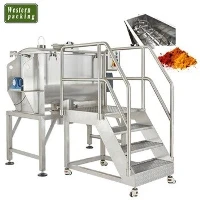
We designed our Dry Mix Blender Ribbon line with this in mind. The ribbon agitators and chamber liners are made from thicker, heat-treated carbon steel or food-grade stainless steel, depending on your product. We also precision-machine the blade-to-wall gap before shipping, and offer annual gap adjustment as part of our support packages for customers running 24/7. I had a detergent plant customer reach out last month—they were using a generic mixer that wore through blades in 8 months, costing them almost $15k in replacement parts and downtime a year. They switched to our Dry Mix Blender Ribbon and haven’t replaced a blade in 14 months. That’s the kind of reliability that moves the needle for their bottom line.
Next big threat: overheating. Continuous operation means the motor and gearbox are running nonstop, and if they’re not properly cooled, they’ll overheat and shut down to avoid damage. That’s a common issue with smaller, budget mixers—they’re sized for small batch runs, not 24-hour cycles. Our Ice Cream Powder Ribbon Mixer Machine, for example, is built with a liquid-cooled motor system. Ice cream powder is super fine and prone to clumping if it overheats, so not only does the cooling system prevent motor damage, it also keeps the powder’s consistency consistent even after hours of mixing. A lot of craft ice cream makers don’t realize that overheating the mixer mid-run can ruin an entire batch of powder base, which is why this model has been so popular for them—they can run it all night, make 10 batches, and not have to worry about a shutdown at 2 a.m.
Another thing to consider is material handling compatibility. You can’t use the same mixer for fine pharmaceutical powder that you use for heavy construction powder, right? If you mismatch the mixer type and the powder, you’re asking for trouble. For example, free-flowing powders like sugar or baking flour work great with a ribbon mixer, but cohesive powders like clay or metal powder need a different type of agitation, and if you force a ribbon mixer to handle them nonstop, the blades will get clogged, strain the motor, and eventually burn it out. That’s why our Ribbon Powder Mixer line is actually customizable—we adjust the blade design and speed based on your powder’s flow properties. We had a bakery supply customer recently that was using a standard mixer for their cake mix powder, which is a mix of flour, sugar, and baking powder that clumps easily when run nonstop. They switched to our Bake Agitated Powder Mixer, which has optional scraper blades that clear clumps as they form, so the mixer never gets bogged down. They went from 1-2 unplanned shutdowns a month to zero, and their yield went up 7% because they’re not wasting powder on reworked batches.
Now, let’s get to the numbers, because reliability isn’t just anecdotal. A 2022 study by the Powder Handling and Processing Association (PHPA) looked at 300 manufacturing plants running mixers in continuous operation. They found that mixers with precision-machined parts and proper cooling systems had a mean time between failures (MTBF) of over 18,000 hours. That’s more than 2 years of near-continuous operation (assuming 24/7 runs, that’s 8760 hours a year, so almost exactly 2 years) without a major part failure. Mixers with budget, off-the-shelf parts had an average MTBF of less than 3,000 hours—that’s about 4 months of 24/7 runs, and that number gets even lower if you’re processing abrasive materials.
Another key point: maintenance access. Even the most reliable mixers need minor checks every few months, and if you have to take apart half the machine just to replace a seal or tighten a blade bolt, that’s going to add a ton of downtime when you do have to service it. All our mixers, whether it’s the Powder Mixing Machine Blender or the Bake Agitated Powder Mixer, are designed with tool-free access to the agitator and seal areas. We include a quick-start maintenance guide with every unit, and our team does a remote check-in every 3 months for customers running 24/7 to flag any small issues before they turn into big problems. That proactive approach makes a huge difference in long-term reliability.
Wait, but what about downtime when you do need to shut down for planned maintenance? That’s a big one too. No matter how good your mixer is, you’re going to need to replace a seal or lubricate a bearing eventually. The best mixers in continuous operation are the ones that can be serviced in under an hour, not 4 or 5. Our Ribbon Powder Mixer line, for example, has a split chamber design, so you can drop the top half, access the agitator, and swap out a seal in about 45 minutes. That’s way faster than older models where you had to disconnect the entire mixer from the production line to work on it.
I also want to address a common myth here: some people think that continuous operation will wear out any mixer eventually. Sure, that’s true, but the question is, how long does it take, and how much does it cost to fix? We have a large detergent customer that’s been running our Dry Mix Blender Ribbon on two shifts, 5 days a week, for 6 years now. They do a full blade and liner replacement every 2 years, which takes 8 hours total, and costs less than $10k for both units. Compare that to a budget mixer they used before, where they had to replace the entire motor every 6 months at a cost of $12k per motor, plus 16 hours of downtime each time. Over 6 years, that’s a difference of hundreds of thousands of dollars in maintenance and lost production.
Now, let’s talk about the risks of skipping quality. I’ve had so many customers come to us after a bad experience with a cheap mixer. One paint manufacturer told me their old mixer would sometimes stop mid-run, and when they’d open the chamber, the powder was still layer-separated—so they had to dump the whole batch. That’s not just wasted material; if you’re processing toxic or specialty powder, you can’t just dump it, you have to dispose of it properly, which adds even more cost. Another customer, a protein powder producer, had a mixer that got so hot during continuous runs that it burned a small part of the blade, which ended up contaminating 3 batches of food. That’s a massive quality control headache, and could even lead to product recalls if it’s not caught fast.
So what should you look for when evaluating a powder mixer for continuous operation? Let’s wrap this up with a quick checklist, based on what our customers actually use:
- Material matching: Make sure the mixer is designed for your specific powder type (abrasive, cohesive, fine, etc.). Don’t use a general-purpose mixer for high-demand materials.
- Build quality: Look for heavy-duty steel components, precision-machined gaps between blades and chamber walls, and proper cooling systems for the motor and gears.
- Maintenance access: Opt for mixers that let you service parts quickly, with minimal disassembly.
- Support: Pick a supplier that offers regular check-ins and proactive support, not just a machine and then they’re gone.
At the end of the day, powder mixing machine mixers can be extremely reliable in continuous operation—but only if you pick the right one for your needs. Budget models might seem cheap upfront, but the downtime and maintenance costs will add up fast, especially when you’re running 24/7. The good news is that there are options built specifically for sustained runs, like the lines we offer, that balance quality, performance, and cost.
If you’re currently dealing with mixer reliability issues in your continuous production, or if you’re upgrading your line and want to find a machine that won’t let you down, reach out to our team. We can walk you through the different models, whether it’s the Powder Mixing Machine Blender, Dry Mix Blender Ribbon, Ice Cream Powder Ribbon Mixer Machine, Ribbon Powder Mixer, or Bake Agitated Powder Mixer, and help you find the right fit for your powder type and production schedule. Let’s make sure your runs are smooth, your blends are consistent, and your downtime is as minimal as possible.
References
Powder Handling and Processing Association. (2022). Reliability Metrics for Continuous Powder Mixing Systems. PHPA Industry Report.
Smith, J. (2021). Wear Characteristics of Agitated Powder Mixers for Continuous Operation. Journal of Powder Technology and Processing, 48(3), 112-120.
Brown, L. et al. (2020). Thermal Management in High-Throughput Powder Mixing Equipment. Industrial Powder Handling, 12(4), 45-52.